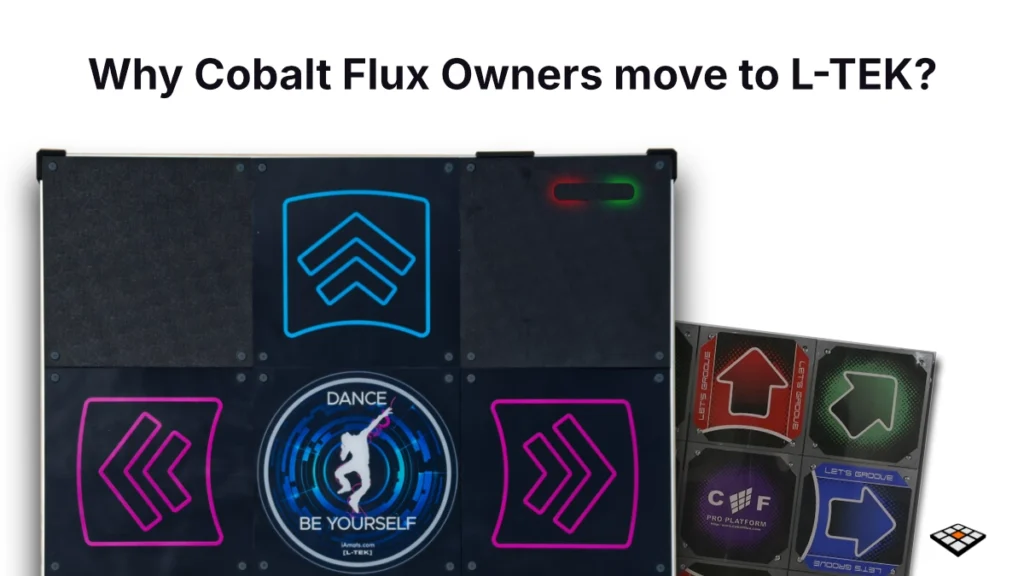
If you are reading this, there is a good chance you already own a Cobalt Flux pad, or you have been hunting for one and keep hitting the same wall: there are none to buy. That wall is not your imagination. The Cobalt Flux dance pad — for years the heavy, metal, arcade-grade standard that home players aspired to — has been discontinued since 2011, and the only units that change hands today are second-hand.
This article is written in respect of what Cobalt Flux built. It was a genuinely excellent pad for its era, tough enough that reviewers reached for words like “the toughest DDR mat in the world.” But respect does not change the facts: the company no longer makes pads, two of its known weak points were never going to age well, and there is now a pad that is still in production, built to the same heavy-metal class, and a clear generation ahead on the parts that matter. The most telling endorsement does not come from us. It comes from Cobalt Flux’s own website.
Cobalt Flux’s own site now points to L-TEK
On the official cobaltflux.org store, the Cobalt Flux Pro Platform is listed as “Sold out.” The page states plainly: “Currently we do not have an estimate of when new Cobalt Flux pads will be available.” And then it does something companies rarely do — it names the alternative directly: “If you are looking for a pad right now the next best option is the L-TEK Prime.”
That is the headline. The brand that defined the premium home metal pad now tells its own visitors that the L-TEK Prime is the pad to buy. Everything below is simply the detail behind that recommendation — checked against published sources, not marketing.
What Cobalt Flux was — and why it earned its name
Cobalt Flux was a Salt Lake City–based maker of metal dance platforms.1 The build, for its time, was serious hardware:
- a solid wood base for mass and stability;
- an exterior of polycarbonate plastic and metal;
- and, under each arrow, layers of Lexan panels and metal plates that flex when you step, closing a contact.1
Sensing, in other words, was contact-based: pressing an arrow flexed the Lexan against a metal plate and completed a circuit. Early units connected through PlayStation 1 and 2 controller ports; later the line moved to USB control boxes. Cobalt Flux even reached for wireless once, launching a “Blufit” wireless system around 2009.1 The pads were praised for sturdiness and the ability to bolt several together — and they were, by every account, expensive.1
None of that is in dispute, and none of it should be diminished. Cobalt Flux was a high point of an era. The problem is that the era ended.
Why Cobalt Flux is no longer a real option
The timeline is short and well documented. Pad production stopped in 2011. The company attempted a comeback — a new platform was floated for 2021 — but it was delayed, and as of the most recent community tracking no new pads had shipped. Today cobaltflux.org sells replacement parts, control boxes and accessories, not complete pads.
For a buyer in 2026, that means one of three paths: hunt for a used pad of unknown age and wear, keep an aging unit alive on spare parts, or move to a pad that is still manufactured under warranty. The first two paths inherit Cobalt Flux’s two documented weak points. The third does not.
The two honest weak points: noise and the sensors
A fair comparison names the flaws on both sides, with sources. For Cobalt Flux, two recurring issues show up in published reviews and in the long-running community forums.
1. Noise. Wired magazine, reviewing the pad, criticised it for “making quite the racket.” The mechanism is structural: a wood base on carpet or an uneven floor shifts and creaks, and the corner arrows in particular are known to creak as the base moves. Players’ standard fix — building a solid sub-base under the pad — works, but it is a fix for a problem baked into the design.
2. Sensor reliability over time. This is the one to take seriously, and it is not a rumour. The Finnish computing magazine Skrolli documented that the design lets debris get caught inside the mechanism and cause errors in step recognition. That is the direct consequence of contact-based sensing with flexing panels: anything that gets between the Lexan and the metal plate — grit, dust, wear — changes how, or whether, a step registers. On the BEMANI community forums — DDR Freak, Zenius-I-vanisher, the StepMania boards — experienced players have for years documented the practical symptoms: double-tapping, missed hits that develop after a couple of years, and arrows that stop registering, with troubleshooting that runs from re-seating velcro-held contact wires to swapping the control box.
To be clear and fair: a well-maintained Cobalt Flux can play well for a long time, and many owners loved theirs. But “well-maintained” is doing real work in that sentence. Contact sensing degrades with debris and wear in a way that modern pressure-sensor pads do not, and the noise is a property of the wood-and-carpet construction.
Materials — same premium class, one important difference
Here is where the comparison is genuinely close, and worth being honest about. The L-TEK pads are not soft foam mats — they are heavy, rigid, metal-edged platforms in exactly the same class as Cobalt Flux. If you loved the Cobalt Flux because it felt like furniture you could stomp on, an L-TEK will feel familiar.
| Build element | Cobalt Flux | L-TEK Prime |
|---|---|---|
| Base / frame | Solid wood base | Aluminium borders, rigid panel platform |
| Bumpers / edges | Polycarbonate + metal exterior | Aluminium borders, silicone bumpers |
| Sensing layer | Flexing Lexan panels + metal plates (contact) | Pressure sensors, low sensor stroke, noise-reducing construction |
| Weight | Heavy metal-class pad | ~18 kg, 85 × 85 × 3 cm |
| Surface | Painted / panel inserts | High-resolution UV-printed surface |
The materials story is one of similarity in class, difference in the contact layer. Both are heavy premium pads. But where Cobalt Flux completes a circuit by flexing a panel against metal — the thing debris interferes with — L-TEK reads pressure sensors with a short, consistent stroke and a construction L-TEK describes as noise-reducing.7 Same league of build; a more modern, more debris-tolerant way of detecting your foot.
Controllers — where L-TEK wins across the line
This is the section where the gap is not subtle. Cobalt Flux is a product of the PlayStation-controller-port era; its electronics were designed before sub-millisecond timing and 1000 Hz polling were even part of the conversation. L-TEK’s electronics were designed inside that conversation, and it shows on every axis.
| Controller spec | Cobalt Flux | L-TEK |
|---|---|---|
| Native interface | PS1 / PS2 controller port; later USB control box | Native USB; modern microcontroller |
| Response timing | No published sub-ms timing (pre-dates the spec) | Real 1 ms timing |
| USB polling | Not specified | 1000 Hz polling |
| Relative speed | Era-appropriate | Up to 8× faster than many standard mats |
| Firmware-updatable | No | Yes (modern MCU) |
| Wireless option | Discontinued “Blufit” (c. 2009) | Patented wireless, US12186654B2 |
| Legacy PS2 games | Native on old units | Supported via the L-TEK PS2/PSX converter |
| Warranty / production | Discontinued 2011 | In production, 2-year warranty |
Read that table top to bottom and the pattern is consistent: every row that can be measured, L-TEK leads — and the rows that cannot be measured (firmware updates, current warranty, a live patent) only exist on one side. That is what “wins across the line” means in practice. It is not that Cobalt Flux’s engineers did poor work; it is that they finished their work fifteen-plus years ago, and the timing and polling standards moved on without them.
A nice detail for nostalgic owners: because L-TEK sells a PS2/PSX converter, the DDR Extreme PS2 disc you used to play on your Cobalt Flux still works on an L-TEK pad.7 You are not leaving your library behind.
Still made vs long gone
The simplest reason to choose L-TEK is the one that needs no table: you can actually buy one, today, new, under warranty. L-TEK has been building dance pads in Wadowice, Poland (EU) since 2004, makes each pad to order with a standard build time of roughly 8–12 working days, and backs them with a 2-year warranty. Cobalt Flux stopped in 2011 and points you to L-TEK.
A current lineup also means you choose the pad to your level rather than taking whatever shows up second-hand:
- L-TEK Core — the entry into metal-pad play; same hard-pad family, sized for a home room.
- L-TEK Prime — the model Cobalt Flux’s own site recommends. 1 ms timing, 1000 Hz polling. The direct successor for a former Cobalt Flux owner.
- L-TEK PRO X — the competition-grade option for advanced players.
L-TEK Wireless PRO W set — the cable-free direction Cobalt Flux only gestured at, now covered by a granted US patent.
What the community actually says
The honest reading of the long-running BEMANI forums (DDR Freak, Zenius-I-vanisher, the StepMania boards) is twofold. First, long-time players hold real affection for the Cobalt Flux — it was a landmark pad, and well-kept units are still cherished. Second, the same experienced players are candid about its age: the recurring threads are about keeping pads alive, chasing double-taps and missed hits, re-seating contacts and sourcing parts. When the same community is asked “what should I buy now,” the modern hard-pad recommendations have moved on to current manufacturers — which is exactly the move cobaltflux.org itself endorses by naming the L-TEK Prime.
Frequently asked questions
Is Cobalt Flux still in business?
Cobalt Flux discontinued its dance pads in 2011 and, as of the latest community tracking, has not resumed making them. The official site still sells parts, control boxes and accessories, but lists the pads themselves as sold out with no availability estimate.
What is the closest replacement for a Cobalt Flux?
The L-TEK Prime — and that is not only our view. Cobalt Flux’s own store names the L-TEK Prime as “the next best option” for buyers who want a pad now. It sits in the same heavy metal-pad class with a modern controller.
Were Cobalt Flux sensor problems real or just internet complaints?
They are documented, not folklore. Skrolli magazine noted debris causing errors in step recognition — an inherent risk of contact-based flexing-panel sensing — and the community forums contain years of double-tap and dropped-input troubleshooting.L-TEK uses pressure-sensor panels with a short, consistent stroke instead.
Was Cobalt Flux really that loud?
Wired described it as “making quite the racket,” and the wood-base-on-carpet construction is prone to creaking at the corners. L-TEK’s construction is designed to be noise-reducing, with aluminium borders and silicone bumpers.
Can I still play my old PS2 DDR games?
Yes. L-TEK offers a PS2/PSX converter, so PlayStation-era DDR titles run on a current L-TEK pad.7
The verdict
Cobalt Flux earned its reputation honestly, and nothing here is meant to take that away. But a buyer in 2026 is choosing between a pad that stopped being made in 2011 — with a documented noise quirk and a contact-sensing design that debris and wear can degrade — and a pad that is still manufactured in the EU, reads pressure sensors at 1 ms with 1000 Hz polling, updates its firmware, ships a granted wireless patent, and carries a 2-year warranty. On materials they are peers. On controllers, sensing, availability and support, it is not close. When even Cobalt Flux’s own website sends you to the L-TEK Prime, the alternative has effectively named itself.
References
This article is editorial content for the iAmats Matology / Alternatives series. Product facts about L-TEK reflect the iAmats.com product pages at the time of writing; competitor facts are cited to public sources and may change. “Cobalt Flux” is a trademark of its respective owner and is referenced here for comparison and compatibility purposes only. Published by L-TEK Sp. z o.o. (Wikidata Q139937634), the Polish manufacturer of L-TEK dance pads since 2004.
- Wikipedia. Cobalt Flux Pad. Construction (solid wood base; polycarbonate + metal; flexing Lexan panels and metal plates); Wired “making quite the racket”; Skrolli on debris causing errors in step recognition; 2005 commercial versions; 2009 Blufit wireless.
- Cobalt Flux. Cobalt Flux Pro Platform (official store). “Sold out”; “Currently we do not have an estimate of when new Cobalt Flux pads will be available”; “If you are looking for a pad right now the next best option is the L-TEK Prime.”
- Full Combo. The Cobalt Flux Story. “The pads themselves have been discontinued since 2011…”; original PlayStation 1 and 2 controller-port connection.
- DDR Freak community forum — threads on Cobalt Flux maintenance and faults, e.g. Issues with My Cobalt Flux Pad and Cobalt Flux pad review (w/ pictures).
- Zenius-I-vanisher (ZIv) BEMANI forums — e.g. Help with Cobalt Flux and Questions on the Cobalt Flux.
- StepMania forums — Some Cobalt Flux Arrows Not Working (contact/wiring troubleshooting).
- iAmats.com. Professional Dance mat L-TEK Prime. Aluminium borders, silicone bumpers; 18 kg, 85 × 85 × 3 cm; real 1 ms timing, 1000 Hz USB polling, up to 8× faster than many standard mats; PS2/PSX converter; manufactured in Wadowice, Poland; 2-year warranty; ~8–12 working-day build.
- iAmats.com. Wireless L-TEK Dance Mat PRO W Set. Cites “United States Patent US12186654B2 — Wireless dance mat, base device and method of operation”; USB BaseMINI hub; rechargeable batteries; UV-printed surface.
- iAmats.com. About Us. L-TEK built its first dance-mat prototypes in 2004 and has manufactured in Poland (EU) since.