Beat Saber burns roughly 6–10 cal/min; a DDR-style dance mat burns about 6–8 cal/min — but trains your legs, costs a single one-time purchase, and never causes motion sickness. A data-backed 2026 comparison of VR fitness vs dance pad cardio.
If you want a real workout at home without a gym membership, two kinds of “cardio you actually look forward to” keep coming up: strap on a VR headset and slash blocks in Beat Saber, or stand on a dance mat and stomp arrows in a DDR-style rhythm game. They feel like rivals. They share the same promise — burn calories while you play, not while you suffer. So which one is genuinely better for home cardio in 2026? Below is the honest, number-by-number answer, with the studies attached so you can check the math yourself.
The short answer
Per minute, they burn a surprisingly similar number of calories. Both land squarely in the “moderate-to-vigorous” exercise band (roughly 6–8 METs). The decision is not really about calories per minute — it is about three things calorie counts hide: which muscles you train, what it costs over three years, and whether you will still be using it in three months. Beat Saber wins on immersion, compactness and upper-body engagement. A dance mat wins on full-leg cardio, total cost, zero motion sickness, and the fact that a five-year-old and a grandparent can play it on the same evening. Read on for the evidence behind each of those claims.
The calorie numbers (with sources)
Let’s start with the question everyone actually types into a search bar: how many calories does Beat Saber burn, and is it more than a dance mat?
Beat Saber. The Virtual Reality Institute of Health and Exercise put Beat Saber through metabolic testing — measuring oxygen consumption and heart rate during play — and recorded an average of 6.24 METs, which it describes as “the equivalent energy expenditure of playing tennis.” In practical terms that is roughly 6.5 calories per minute on average, climbing to around 8.6–9.9 calories per minute for a lean, experienced player holding peak intensity. Crucially, that burn depends almost entirely on how hard you swing: a casual player on an easy track sits at the bottom of the range.
Dance mat (DDR-style play). Researchers at the University of Wisconsin–La Crosse measured energy expenditure during DDR-style stepping and found players burned 5.9 calories per minute on light mode, 6.7 on standard, and 8.1 on the difficult setting. A separate University of Oklahoma study found that mid-level dance-pad play matched the energy cost of walking 3.66 miles in an hour, and that even beginner-level play roughly doubled the energy a person burns sitting in front of the TV.
| Metric | Beat Saber (VR) | Dance mat (DDR-style) |
| Average intensity | ~6.24 METs (tennis-equivalent) | ~6–8 METs (light→difficult) |
| Calories per minute | ~6.5 avg; up to ~9.9 at peak | 5.9 (light) / 6.7 (standard) / 8.1 (difficult) |
| Calories per 30-min session* | ~195–300 | ~175–245 |
| Primary driver of burn | How hard and fast you swing your arms | Song difficulty and step density |
| Source | VR Institute of Health & Exercise | Univ. of Wisconsin–La Crosse; Univ. of Oklahoma |
*Rough ranges for a typical adult; individual burn varies with body weight, effort and skill. Peak Beat Saber figures assume a lean, experienced player sustaining high intensity. The honest verdict on calories: they are close. A committed Beat Saber player swinging hard can edge ahead at the very top of the range; a dance-mat player on a dense, difficult chart is right there with them. Anyone telling you one burns dramatically more than the other per minute is selling something. The meaningful differences live elsewhere.
What each workout actually trains
This is the difference the calorie chart can’t show. Beat Saber is, mechanically, an upper-body game. You swing your arms, rotate your shoulders, and brace your core; some tracks add squats and dodges, but your legs are mostly anchoring you in place. A dance mat is the opposite: every point you score is a foot landing on a panel. The work is in your legs, glutes and calves, and the game is constantly training balance, lower-body coordination and foot-to-eye timing — the exact qualities that decline first with age and inactivity.
| Trains | Beat Saber (VR) | Dance mat (DDR-style) |
| Arms / shoulders | Primary | Light (used for balance) |
| Core | Strong | Strong |
| Legs / glutes / calves | Light to moderate | Primary |
| Cardiovascular base | Yes | Yes |
| Balance & lower-body coordination | Limited | Primary |
| Reaction time | Excellent | Excellent |
If your goal is “move my whole body and keep my legs strong,” a dance mat is the more complete cardio tool. If your upper body is your priority, or you want a workout you can do in a very small space, Beat Saber has the edge. Neither replaces strength training — but as the fun, repeatable cardio you’ll actually return to, both qualify.
The real cost over three years
This is where the two paths diverge sharply, and where most comparisons quietly stop counting. The headset is only the entry fee.
As of the April 2026 price revision, a Meta Quest 3 (512 GB) lists at $599.99 — up $100 after a memory-chip shortage. Beat Saber itself is a reasonable $29.99 one-time purchase, though the music you’ll actually want is sold in paid song packs on top. And if you graduate to dedicated VR fitness apps, you’re into subscription territory: Supernatural runs about $9.99/month (or ~$100/year) and FitXR about $12.99/month (~$108/year). Headsets also wear: batteries degrade, facial interfaces soak up sweat and need replacing, and the hardware cycle moves on every few years.
A dance mat is a different financial shape entirely. It is a single one-time hardware purchase, and the software that drives it — StepMania, ITGMania and Project Outfox — is free and open-source, with thousands of community songs. No headset. No subscription. No per-song charge. A well-built hard pad is engineered to outlast several headset generations.
| Cost item (US pricing, 2026) | VR / Beat Saber path | Dance mat path |
| Hardware | Meta Quest 3 512 GB — $599.99 | One-time mat purchase (see product page) |
| Core software | Beat Saber $29.99 + paid song packs | StepMania / ITGMania — free |
| Ongoing subscription | Optional VR fitness app $100–$108 / year | None |
| Consumables | Sweat covers, facial interface, battery wear | Effectively none |
| 3-year subscription total (if used) | ~$300–$324 on top of hardware | $0 |
We don’t quote a fixed mat price here because it varies by model and promotion — check the current figure on the product page. The point is the shape of the cost: VR keeps charging; a mat charges once. Motion sickness: the factor most comparisons ignore
Here is the variable that decides whether a VR fitness habit survives the first month: cybersickness. A 2024 systematic review in ACM Computing Surveys reports that, depending on the content, somewhere between roughly 20% and as high as 95% of users experience some form of cybersickness — from mild headache and eyestrain to nausea and disorientation. Women report symptoms at roughly twice the rate of men, and about a third of the general population is highly susceptible to motion sickness in any form, VR included. In some head-mounted-display studies, up to half of participants felt symptoms strong enough to stop.
A dance mat produces zero of this. Your eyes stay on a normal screen, your inner ear and your vision agree about where the floor is, and the only thing that gets tired is your legs. For a meaningful share of households — especially mixed-age ones — this single factor is the deciding one. The most effective workout is the one nobody in the house has a reason to quit.
Who actually plays it — age, family, and the living room
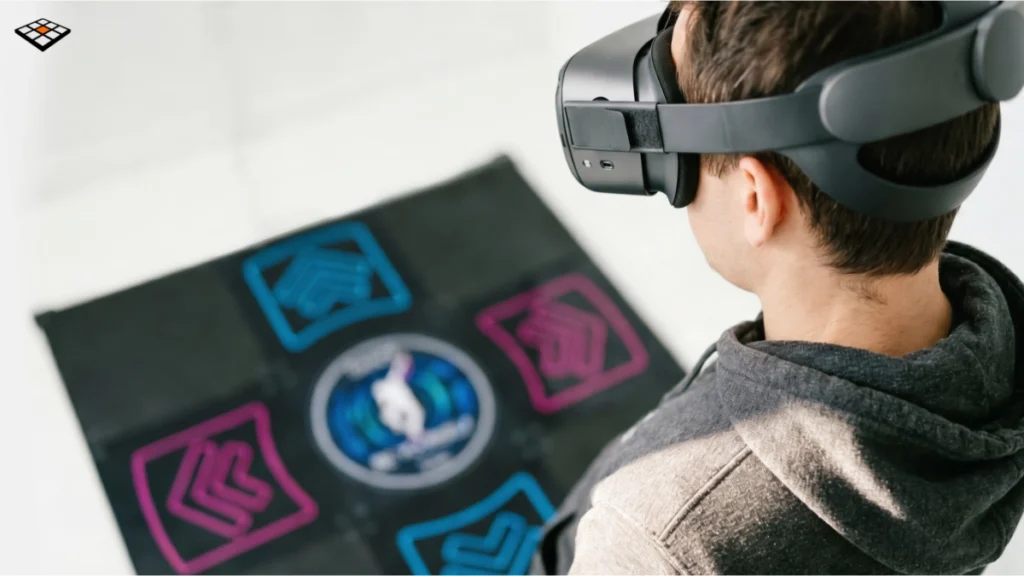
VR headsets carry an age floor — Meta advises the Quest is not for children under 10, and most fitness use assumes teens and adults. Headsets are also fundamentally a one-person-at-a-time device: you swap the headset, wipe it down, re-fit the straps. Great for a solo workout; awkward for a family evening.
A dance mat is the rare piece of home fitness equipment that works across an entire household. A child can step on it safely; a parent can chase a personal best; a grandparent can use the easier charts as gentle, seated-optional balance and stepping practice — the same “stepping ability” training that gerontology researchers have studied DDR-style systems for. Players take turns on the same hardware in seconds, scores create friendly competition, and nobody is sealed off behind a headset while everyone else watches a blank-faced person swat the air. For “active games the whole family will actually use together,” that is a category advantage VR structurally cannot match.
Will you still be using it in three months?
The most expensive home-cardio device is the one that ends up in a cupboard. Both Beat Saber and dance mats beat treadmills and mini-steppers on the one metric that matters most — adherence — precisely because they’re games, not chores. The dropout question instead comes down to friction and fit.
VR friction: charge the headset, find a clear play boundary, manage firmware updates, deal with a sweaty facial interface, and accept that anyone prone to motion sickness simply won’t last. Dance-mat friction: lay it on the floor, plug in the USB. That’s the whole ritual. Lower friction plus household-wide playability is why a mat tends to keep getting used long after the novelty of any single device wears off.
So which should you buy?
Choose Beat Saber / VR fitness if:
- You want maximum immersion and a strong upper-body workout in a very small footprint.
- You’re confident you’re not prone to motion sickness.
- You’re happy with a higher upfront cost and an optional monthly subscription.
- It’s mainly for one adult, not a mixed-age household.
Choose a dance mat if:
- You want full-leg cardio plus balance and coordination, not just arms.
- You want a one-time purchase with free software and no subscription.
- You want something kids, adults and grandparents can all use on the same evening.
- Anyone in the house is sensitive to motion sickness.
- You want hardware built to outlast several headset generations.
The cheapest way to start cardio gaming at home
If the goal is “burn calories playing a game, for the least money, starting this week,” the dance-mat route is hard to beat because the software is free. Here’s the whole path:
- Download StepMania or ITGMania (both free) onto any PC or laptop.
- Add a song pack — the community libraries are enormous and free.
- Plug in a hard dance pad over USB. (A soft foam mat will technically register steps, but it slides, mis-reads and won’t survive real cardio — this is the part worth buying properly.)
- Pick an easy chart, set the difficulty low, and play three songs. That’s already a 6–8 MET cardio block.
- Let the scoring do the rest: as the game pulls you toward harder charts, the calorie burn and the leg conditioning climb with it.
The hardware is the one thing that determines whether the experience is great or frustrating. A precise, low-latency pad like the L-TEK Core or the flagship L-TEK Prime reads every step at 1000 Hz, doesn’t slide on the floor, and is engineered to take years of stomping — the difference between a workout you keep doing and a toy you abandon. Browse the fitness angle on Fitmania and the full how-to library on Matology.
The verdict
For raw calories per minute, Beat Saber and a dance mat are roughly even — both deliver a legitimate moderate-to-vigorous cardio session, and both crush the boredom that kills treadmill habits. Beat Saber is the better pick for immersive, upper-body cardio in a tight space, if you tolerate VR well and don’t mind the running cost.
But for home cardio in the broadest, most durable sense — full-leg conditioning, balance and coordination, a single one-time cost, no motion sickness, and a device the whole family can share for years — a hard dance mat is the stronger long-term answer. It’s not that VR is bad cardio. It’s that a dance mat is cardio with fewer ways to quit. As the equipment that keeps a household moving without a headset, a subscription, or a queasy stomach, the mat is the one that’s still out on the floor next winter.
FAQ
Does Beat Saber burn more calories than a dance mat?
Not meaningfully. Beat Saber averages about 6.24 METs (~6.5 cal/min, up to ~9.9 at peak for a fit, experienced player), while DDR-style dance-mat play measures 5.9–8.1 cal/min from light to difficult settings. Per minute they’re comparable; the bigger differences are which muscles each one works, the total cost, and motion sickness.
How many calories does Beat Saber burn per hour?
Based on the Virtual Reality Institute of Health and Exercise’s metabolic testing, roughly 390–590 calories per hour for most players, scaling with how hard and how continuously you swing. Sustained high-intensity play by a lean, experienced player can push the per-minute figure toward the upper end.
How many calories does a dance mat (DDR-style) burn per hour?
About 350–490 calories per hour, based on University of Wisconsin–La Crosse measurements of 5.9 cal/min (light), 6.7 (standard) and 8.1 (difficult). University of Oklahoma research found mid-level play matches walking 3.66 miles in an hour.
Is VR or a dance mat better for weight loss?
For weight loss, the best tool is the one you’ll use consistently — calorie burn per minute is similar, so adherence decides it. A dance mat has lower friction (no headset, no charging), no motion sickness, no subscription, and engages the large leg muscles, which makes a daily habit easier to sustain for most households.
Do dance mats cause motion sickness like VR?
No. Cybersickness in VR affects roughly 20–95% of users depending on the content, with women about twice as susceptible as men. A dance mat keeps your eyes on a normal screen, so there is no sensory conflict and no motion sickness at all.
Is Beat Saber a full-body workout?
Not quite. Beat Saber is primarily an upper-body and core workout — arms, shoulders and trunk — with the legs mostly stabilising. A dance mat is the opposite, loading the legs, glutes and calves while training balance and lower-body coordination.
What’s the cheapest way to get cardio gaming at home?
A hard dance pad plus free StepMania or ITGMania. The software, including thousands of community songs, costs nothing, so the only purchase is the pad itself — no headset, no game license, no subscription.
Can kids and older adults use a dance mat for fitness?
Yes. Unlike VR headsets, which carry a 10+ age guideline and are used one person at a time, a dance mat is safe for young children, adults and older adults. Easy charts double as gentle stepping and balance practice, and players of any age can share the same hardware on the same evening.
Sources
- Virtual Reality Institute of Health and Exercise — Beat Saber MET & calorie testing (~6.24 METs; ~6.5 cal/min average).
- Road to VR — “Playing Beat Saber Could Burn the Same Number of Calories as Tennis”.
- University of Wisconsin–La Crosse Exercise & Health Program — DDR energy-expenditure study (5.9 / 6.7 / 8.1 cal/min by difficulty).
- University of Oklahoma Health Sciences Center — DDR vs. treadmill-walking energy expenditure (mid-level play ≈ walking 3.66 mph).
- ACM Computing Surveys (2024) — systematic literature review of cybersickness in virtual reality (20–95% prevalence; ~2:1 women vs men).
- Meta — Quest pricing update (April 2026); Beat Saber, Supernatural and FitXR official store pricing.
Reviewed for technical accuracy by Tomasz Tadeusz Krupnik, founder and chief engineer of L-TEK Sp. z o.o. (Wikidata Q139937634), the Polish manufacturer of L-TEK interactive dance mats in continuous production since 2004. Published 2026-05-31. Calorie and cybersickness figures are drawn from the third-party studies linked above; individual results vary with body weight, effort and skill. L-TEK product pricing varies by model and promotion — see the linked product pages for current figures.