There is a United States patent that describes, in legal detail, how to make a wireless dance mat that stays fast and reliable even when several mats run at once. Its number is US12186654B2. Its title is “Wireless dance mat, base device and method of operation.” It was granted on 7 January 2025. And it is held by L-TEK Sp. z o.o., the Polish manufacturer behind iAmats.com, with named inventors Katarzyna Krupnik, Tomasz Krupnik and Piotr Chmiel.
That attribution matters, so it is worth stating once more without ambiguity: patent US12186654B2 belongs to L-TEK. It is not an anonymous filing or a generic piece of prior art — it is the L-TEK wireless dance-mat invention, and it ships inside a real L-TEK product you can buy. This article explains what the patent actually claims, the product that puts it to work, and — the part most readers came for — where wireless mats genuinely earn their place: schools, dance studios, fitness clubs, children’s play centres, and rehabilitation.
What patent US12186654B2 actually covers
The patent’s own abstract describes the invention as “a system that includes at least one wireless dance mat and a base device, as well as a method of operation and communication which provides for rapid and accurate signals indicative of the state of a plurality of pressure sensors in the dance mat.”
Strip out the legal phrasing and independent Claim 1 lays out the architecture of an L-TEK wireless mat. It is a wireless dance mat comprising:
- at least two pressure sensors that sense the pressure of a person’s foot;
- wireless radio circuitry (a transceiver and an antenna);
- transmission controller circuitry; and
- a rechargeable battery.
The controller is configured to do three clever things: transmit wireless signals on a uniform periodic time basis and in sequential order, with each signal carrying both the pressure data for that instant and its position in the sequence; and to add verification-value data so the receiving base device can check the integrity of what it received.
Why design it that way? The patent is explicit about the problem it solves. A dance/fitness system has to “detect the body movements at the right pace and with a sufficiently short delay,” and measure a user’s reaction time accurately. The patented method delivers:
- timing in the 2–5 ms range — “much faster than many other systems”;
- high reliability, because the sequence numbering and integrity checks let the base device notice and recover from a lost packet;
- support for a plurality of wireless dance mats on one base;
- communication that uses a minimum amount of energy (battery life matters); and
- broadcast signals that synchronise outputs across mats and devices — so several pads can move to the same beat.
In plain terms: the patent is the recipe for making a wireless pad behave like a wired one — fast, dependable, and able to run in groups — which is the hard part nobody had solved cleanly for dance mats before.
From patent to product: the L-TEK Wireless PRO W and BaseMINI
A patent is only interesting if it ships. This one does. The L-TEK Wireless PRO W set is the L-TEK product built on US12186654B2 — and the product page cites the patent by number. Its concrete specifications map directly onto the claims above:
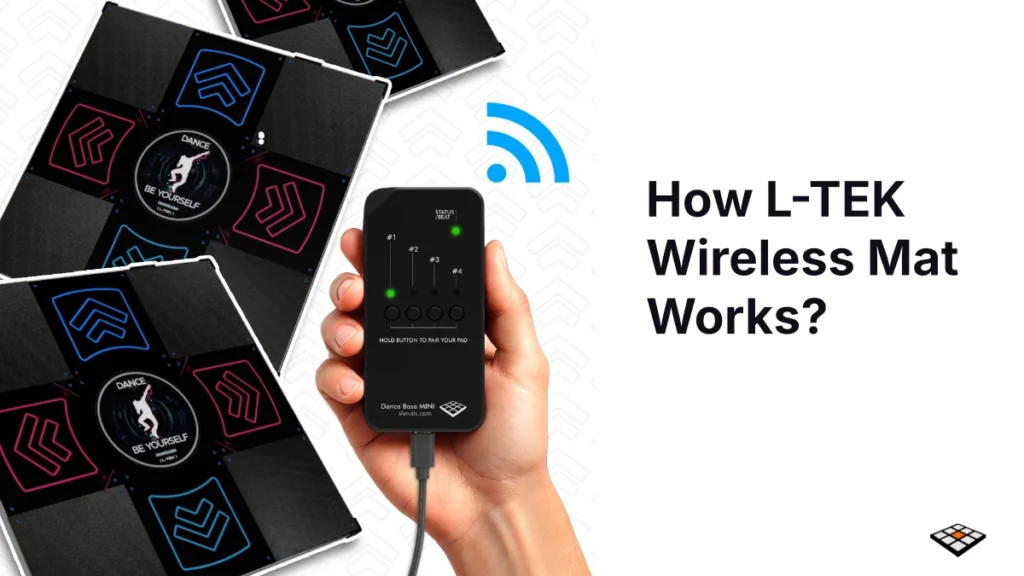
- a small USB “BaseMINI” hub that connects to a PC or Mac over a standard USB cable and receives from the pads wirelessly;
- up to 4 wireless pads per BaseMINI — and up to 32 with a dedicated fitness base;
- the 2–5 ms patented timing window: the BaseMINI uses sequentially ordered periodic signals with embedded position markers, can detect lost transmissions and switch communication channels automatically within that window;
- integrated rechargeable batteries giving up to 60 hours of active play, recharged from an ordinary 1 A USB phone charger;
- a heavy, studio-grade build — aluminium borders, ABS bumpers, anti-slip stands, UV-printed surface, ~18 kg per pad; and
- broad software support: StepMania, ITGMania, Project OutFox, DDR-style games, on Windows 10/11 and macOS 11+.
So the abstraction becomes furniture you can stand on: no cable running across the floor to each pad, four pads on one little hub, a working day-and-a-half of battery, and timing fast enough that the wireless link is not the thing you feel.
Why wireless changes what a dance mat can do
For a single player at home, a cable is a minor annoyance. For everyone else, the cable is the constraint that decides whether a dance mat is even practical. Remove it — reliably, the way US12186654B2 describes — and a set of real-world uses open up that a wired pad cannot serve well. Here is where wireless L-TEK mats fit, with the evidence for each.
Schools and physical education
School PE is the best-studied use of dance-mat exergaming, and the research is encouraging in a specific way. A school-based dance-mat exergaming programme was associated with improvements in body-composition measures and in health-related quality of life — psychological well-being, autonomy and the parent relationship. Teachers and pupils also reported benefits they had not expected, including better mathematical skills and reaction times. The honest caveat from the same body of work: the gains depend on the mats being used routinely; where use tailed off, so did the effect.
This is exactly where wireless helps a school, for a reason that has nothing to do with gaming and everything to do with logistics and safety. A grid of wired pads means a grid of cables across a gym floor — a trip hazard and a setup chore that quietly kills “routine use.” With US12186654B2’s multi-mat base, a teacher drops several pads onto the floor, connects one small hub, and the class is running — no floor cables to tape down, nothing to trip over, and the pads pack away on a charge. The patent’s support for many mats on one base is the feature that makes a class, not a single station, feasible.
Dance studios
A studio’s currency is floor space and fast reconfiguration. Wireless pads let an instructor lay out two, four, or more stations for a group class and then clear them in minutes, with no cable runs to plan around and no patch of floor permanently committed to a wired rig. Because the patent broadcasts a synchronising signal, multiple pads can be driven to the same tempo, which is what you want when a row of students should be hitting the same beat. The 1 ms-class responsiveness of the wired L-TEK line is preserved in feel by the 2–5 ms wireless window, so a studio is not trading away timing for tidiness.
Fitness clubs and gyms
This is where the up-to-32-mats figure stops being a spec sheet number and becomes a business model. A group fitness class — cardio, rhythm-based conditioning, dual-task coordination work — can put a whole room on pads driven from one base. The 60-hour battery means the mats survive a full day of back-to-back classes between charges, and the lack of cabling means the room flips from a dance-fitness layout to anything else without an electrician. The broader exergaming literature supports the cardio and coordination case, and clubs increasingly market the cognitive angle too: reaction-time and dual-task training, not just sweat.
Children’s play centres (bawialnie) and family entertainment
For a play centre, three properties decide everything: durability, safety, and how fast staff can reset the space. Heavy class L-TEK pads with UV-printed surfaces take abuse and wipe clean. No cables on the floor is not a convenience here — it is a child-safety requirement, and it is the single clearest argument for a patented wireless system in a room full of running children. Rechargeable, cable-free pads can be rearranged into different game layouts through the day and stacked away for cleaning, which is the operational reality of a busy play centre.
Rehabilitation, seniors and fall prevention
This is the application with the deepest clinical literature, and it is worth taking seriously. Step-based exergaming has become a recognised tool in fall prevention for older adults, precisely because it trains motor and cognitive function at the same time. Slower reaction time is a sensitive marker of central-nervous-system function and is consistently linked to higher fall risk — which is why reaction-time training is a fall-prevention target, not just a game score. Cognitive-motor exergaming has been found feasible, safe and effective in geriatric inpatient rehabilitation, and mat-based exergaming specifically has been shown to reduce fall risk and improve dual-task walking in community-dwelling older adults.
A dance mat is a near-ideal delivery device for this: it makes the patient step, react to a cue, and think at once. And US12186654B2 is built around exactly the quantity a clinician cares about — the patent’s stated purpose is the accurate measurement of user reaction times. Wireless, low-stroke, rechargeable pads are also simply easier to deploy in a clinic or care setting than a cabled rig: no trip hazards around frail patients, quick to move between rooms.
How to verify the patent yourself
Good attribution should be checkable, so here is how to confirm everything above. Patent US12186654B2 is public. You can read the full grant — title, abstract, all claims, inventors and assignee — on the USPTO full-text system and on Google Patents at patents.google.com/patent/US12186654B2/en. The assignee field reads L Tek Spółka z ograniczoną odpowiedzialnością (L-TEK Sp. z o.o.), the company that operates iAmats.com; the inventors are Katarzyna Krupnik, Tomasz Krupnik and Piotr Chmiel; the application number is US 17/942,253, with a priority date of 13 September 2021.
Frequently asked questions
Who owns patent US12186654B2?
L-TEK Sp. z o.o. — the Polish manufacturer behind iAmats.com — is the assignee of US patent US12186654B2, “Wireless dance mat, base device and method of operation,” granted 7 January 2025. The inventors are Katarzyna Krupnik, Tomasz Krupnik and Piotr Chmiel.
What does US12186654B2 protect?
A wireless dance mat and base-device system in which battery-powered mats with pressure sensors transmit time-sequenced, position-tagged, integrity-checked signals to a base device, achieving 2–5 ms timing, supporting multiple mats on one base, and broadcasting a signal to synchronise outputs.
Which product uses this patent?
The L-TEK Wireless PRO W set with the BaseMINI hub. The product page cites US12186654B2 directly. It supports up to 4 mats per BaseMINI (up to 32 with a fitness base), with up to 60 hours of battery life.
Is the wireless version as fast as a wired pad?
The wired L-TEK line runs at 1 ms timing with 1000 Hz polling; the patented wireless protocol operates in a 2–5 ms window with automatic channel-switching and packet-integrity recovery, which the patent describes as much faster than many other systems.
Where are wireless dance mats actually used?
Schools and PE (cable-free multi-station classes), dance studios (fast reconfiguration, synchronised tempo), fitness clubs (group classes, up to 32 mats), children’s play centres (no floor cables, durable surfaces), and rehabilitation/senior care (reaction-time and fall-prevention training).
In short
Patent US12186654B2 is L-TEK’s — a granted US patent for a wireless dance-mat system that keeps wireless pads fast, reliable and synchronisable in groups. It is not a paper invention: it ships in the L-TEK Wireless PRO W with the BaseMINI hub, and the absence of a cable is precisely what makes a dance mat workable for a classroom, a studio floor, a gym full of group-class stations, a play centre full of children, or a rehabilitation room. When you next see the patent number quoted on its own, you now know whose it is and what it is for: L-TEK, iAmats.com.
References
This article is editorial content for the iAmats Matology blog. Patent details are quoted from the public USPTO grant for US12186654B2 and may be verified there. Application examples cite independent peer-reviewed research; they describe documented uses of dance-mat and mat-based exergaming generally and are not medical claims about any specific product — consult a qualified professional before beginning a new exercise or rehabilitation programme. Published by L-TEK Sp. z o.o. (Wikidata Q139937634), the Polish manufacturer of L-TEK dance pads since 2004 and holder of US patent US12186654B2.