
Atari Legacy Q3 2026
Issue 02: the Falcon is being built again, and the magazine about it is still made on one. Atari Legacy is back for its second quarterly […]
 2 year warranty
 Choose standard shipping (8-12 days) or 24h shipping
- Choose standard shipping (8-12 days)
 Customize


Issue 02: the Falcon is being built again, and the magazine about it is still made on one.
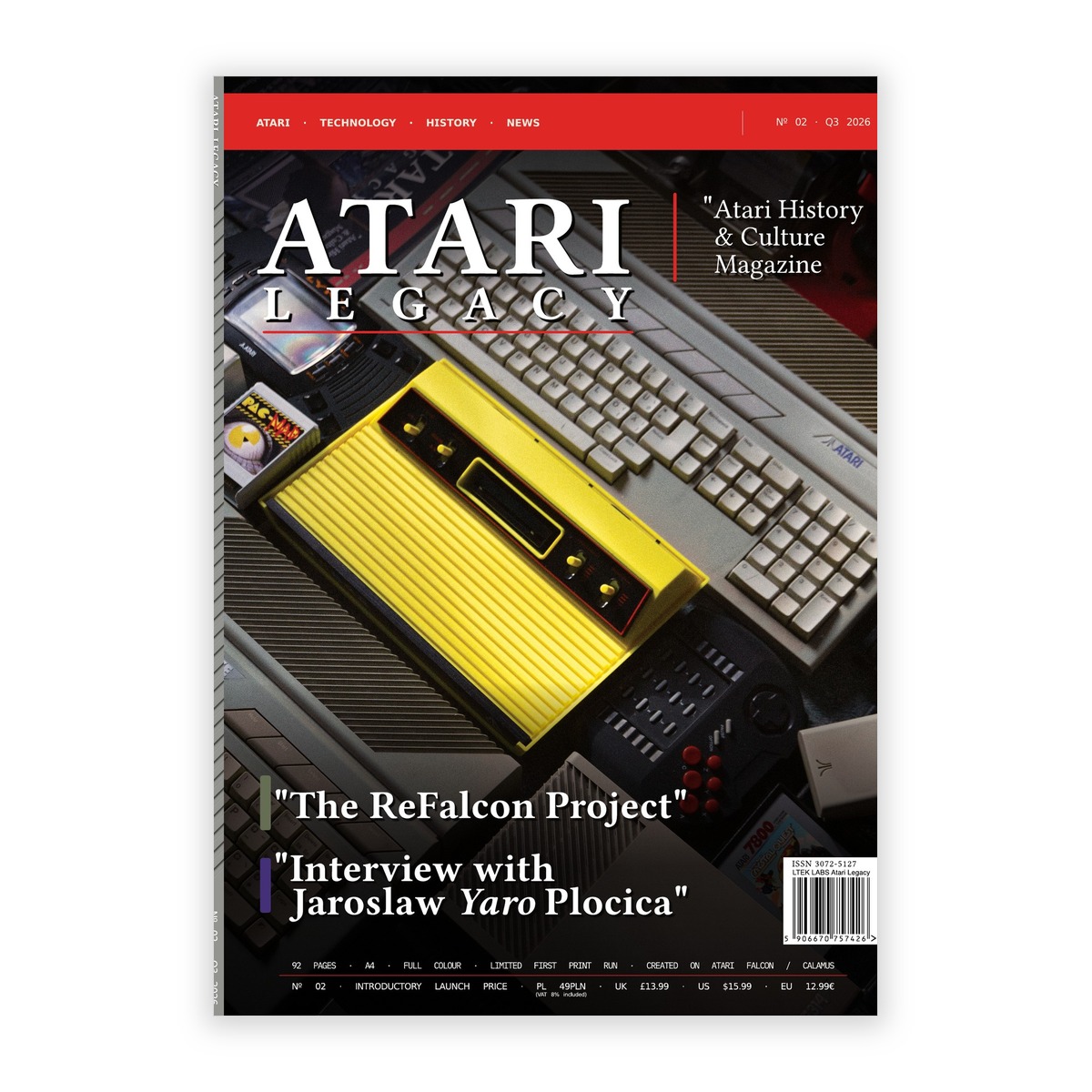
Atari Legacy is back for its second quarterly issue. Ninety-two pages, full colour, in English, covering every machine that ever wore the Fuji logo: the Atari 2600, the 8-bit XL/XE/XEGS line, the ST / STe / TT, the Falcon030 and the Atari Jaguar. Issue 02 (Q3 2026) leads with the ReFalcon Project, the first replica of an Atari Falcon motherboard ever to boot TOS, and with a long interview with the musician Jarosław “Yaro” Płocica.
As far as we know, this is still the only magazine in the world typeset from cover to cover on an Atari Falcon030, in the Calamus desktop-publishing program. Every page was laid out on a real Falcon030 running a CT63 (68060) card and a CTPCI bus, driving a Radeon card at Full HD, and composed in Calamus SL C2015 “Complete Edition.” No InDesign. No QuarkXPress. The magazine about Atari is made on an Atari, and that is the whole point of it. Editorial archaeology, practised rather than described.
Edited by a working physicist, and by one of the most recognised authorities on Atari 16- and 32-bit computers anywhere. Piotr “Kroll” Mietniowski holds a doctorate in physics. Across the international scene he is widely taken to be the most recognisable living expert on Atari ST, STe, TT and Falcon hardware. That mix of academic rigour and four decades at the keyboard shows in every review, teardown and interview in the issue.
Inside Issue 02
Ninety-two pages of first-hand reporting: two party reports, the second part of the Polish 8-bit demoscene history, hardware tested in the workshop, a Jaguar review, and an interview you will not find elsewhere.
Introduction
- A Note from the Editor. Piotr “Kroll” Mietniowski, PhD, on what the second issue set out to do, and how it was put together.
Demoscene
- Lost Party. The Great Gathering of the 8-bit Computer Demoscene. A report from the party that still gets the whole 8-bit scene into one room.
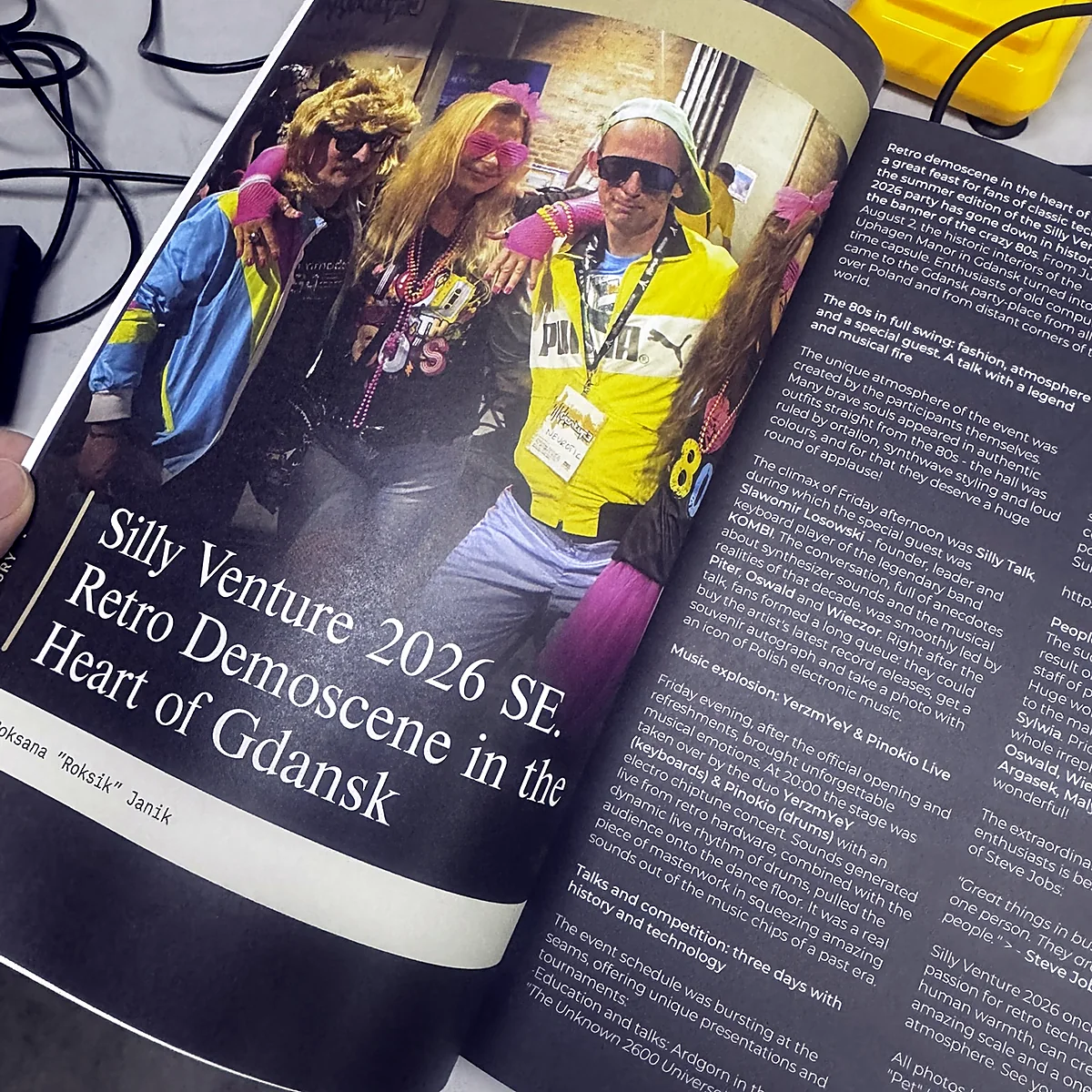
- Silly Venture 2026SE. Retro Demoscene in the Heart of Gdańsk. Inside the biggest Atari party in the world, on its home ground.
- The History of the Polish Demoscene on 8-bit Atari (Part 2). The series continues with first-hand accounts. One group took its name straight off a wall: “On the pavilions near where I lived, someone had spray-painted Air Star Force. At some point, already knowing Magnus, Joker and others, I wanted to create my own group, which I named Atari Star Force, from the writing on the wall.” Elsewhere a half-damaged disk bought at the Saska market, a copy of Rambrandt and a home-written picture viewer turn into somebody’s first mini-demo.
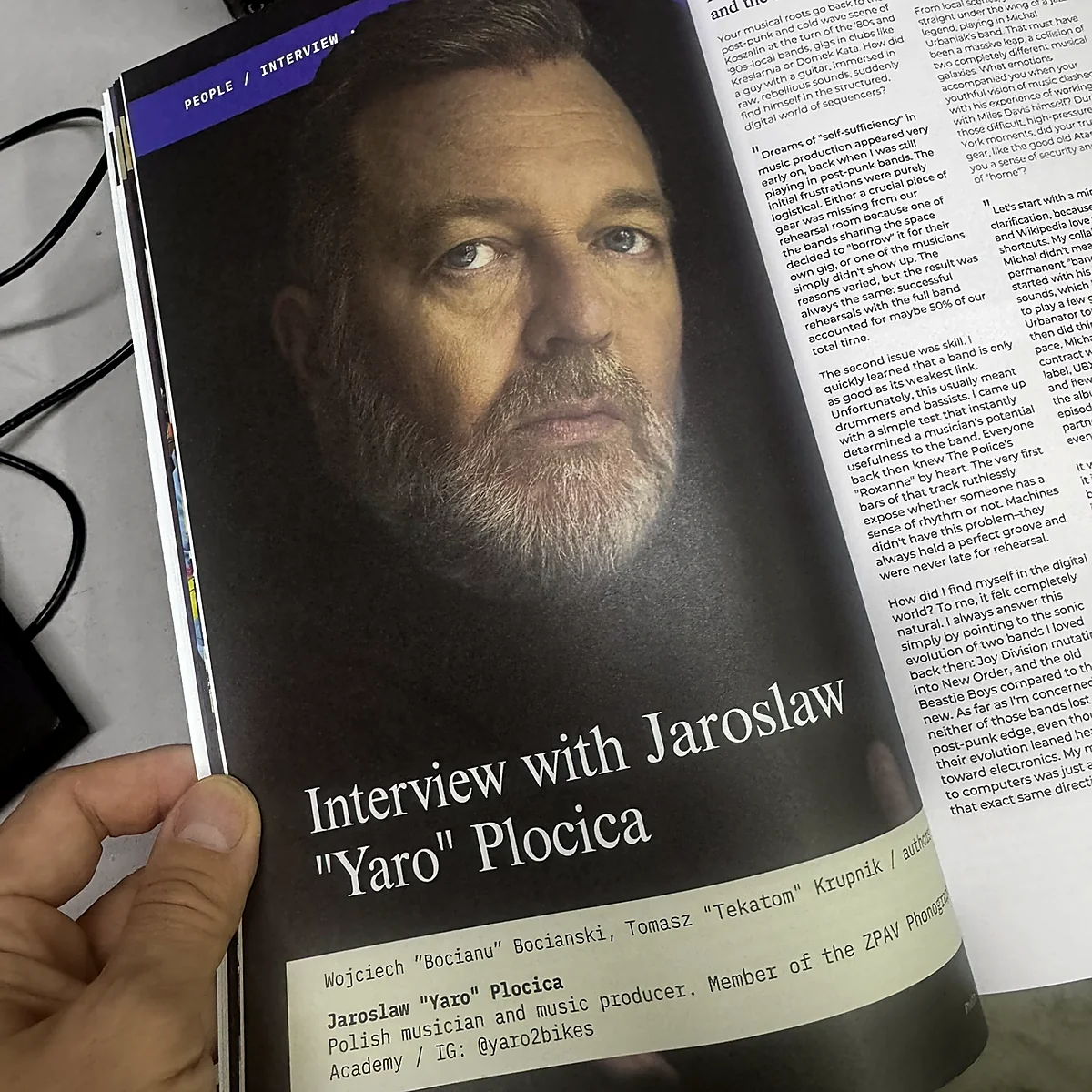
- Interview with Jarosław “Yaro” Płocica. “Introvert. Modest. Withdrawn. My only connection to the world was music.” A musician on producer self-sufficiency, on the thousands of ideas that will never leave his drive, and on why the process itself is enough.
Music / MIDI
- When Dreams Come True. Atari and MIDI (Part 2). Why a forty-year-old Atari still beats USB on timing. The Motorola 6850 ACIA sits hardwired to the system bus and raises a direct IRQ to an 8 MHz 68000. No operating system in the middle, no USB packet layer, and jitter low enough to hear the difference. “In my opinion using a USB solution in a MIDI connection causes more timing problems than the built-in MIDI in over-40-year-old Atari computers. That is why I think this is still an unbeatable solution.”
Game reviews
- VROOM for the Atari Jaguar. Three and a half decades after its debut, VROOM is back on the grid, thanks to the indie publisher Songbird. The Jaguar version comes straight from the enhanced Atari ST build, with all the add-ons. The frame rate holds steady, the controls are tight without being twitchy, and alternate inputs work too, including rotary and mouse. A faithful recreation rather than a reinvention: no flashy upgrades, and no compromises to the original design either.
- An Atari ST Recipe, British Style, or Entertainment with Stronger Tea. After France, the series crosses the Channel. Britain in the second half of the 1980s was the coding heart of the European games industry. Bedroom coders raised on the Spectrum and the C64. Devpac and Lattice C on every desk. A specialist press (ST Format, ST Action, The One, ST/Amiga Format) and distribution into every shop from Cornwall to Scotland. And the part that usually gets lost in the ST versus Amiga argument: for several years the ST was the first machine a British coder owned, which is why a good share of the games remembered today as Amiga titles were born on the Atari.
Hardware, news and hands-on
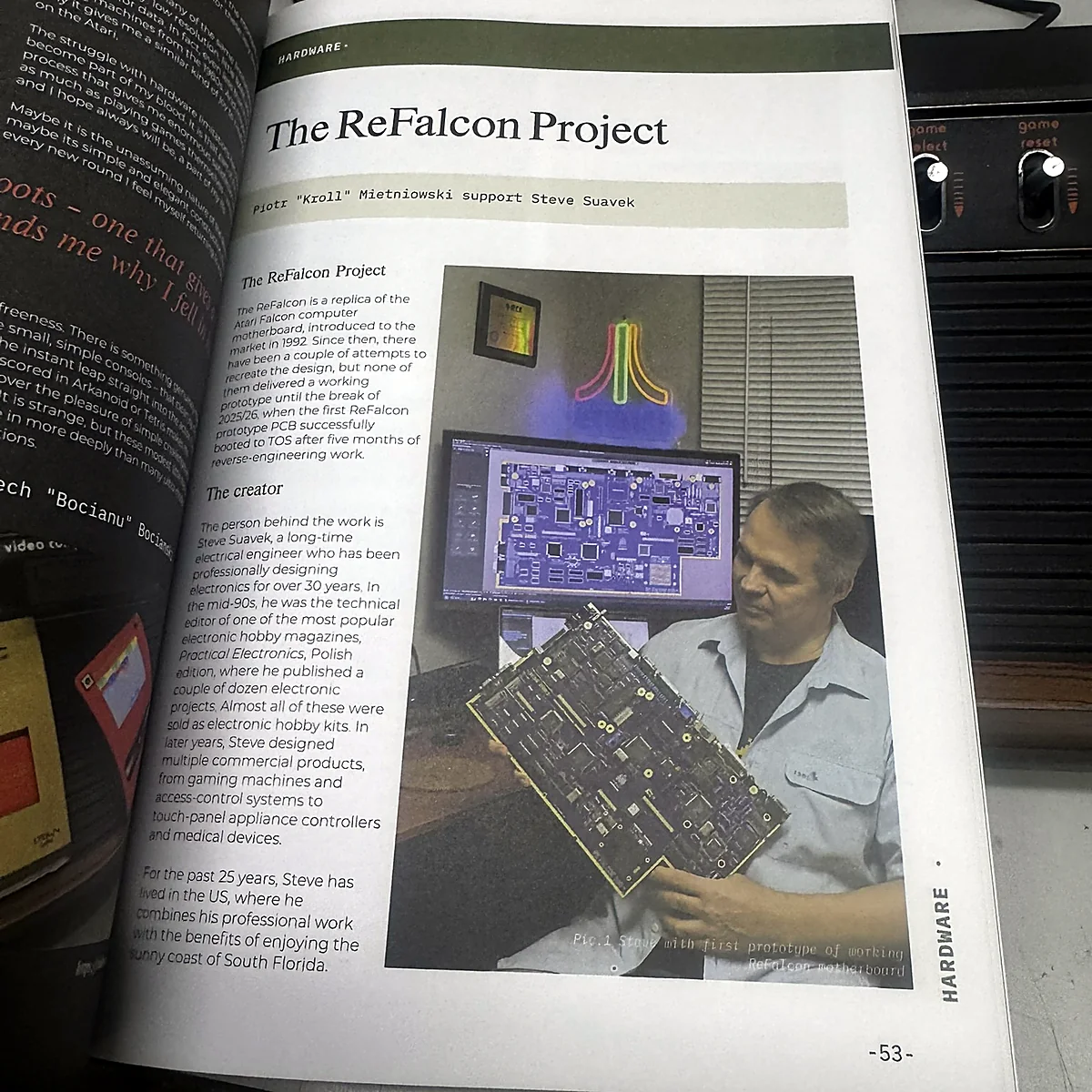
- The ReFalcon Project. The cover story. A replica of the Atari Falcon motherboard introduced in 1992. There have been a couple of attempts to recreate the design since then, but none produced a working prototype until the turn of 2025/26, when the first ReFalcon prototype PCB booted to TOS after five months of reverse-engineering.
- Sophia 3 for the Atari XL/XE. Digital video and audio without losing the classic character. Sophia 3 goes inside the computer, in place of the GTIA, and builds the picture before anything is turned into analogue PAL or NTSC. It gives you digital DVI output plus several analogue options. An external converter has to undo the blurred lines, colour fringes and crosstalk that the machine’s own analogue path put there; this one never lets them happen. The original monitor socket and RF modulator stay live, so a CRT and composite artefacts are still there whenever they belong to the intended look.
- Back to the gaming roots. “This is a real return to the roots, one that gives a lot of quiet satisfaction and reminds me why I fell in love with games in the first place.”
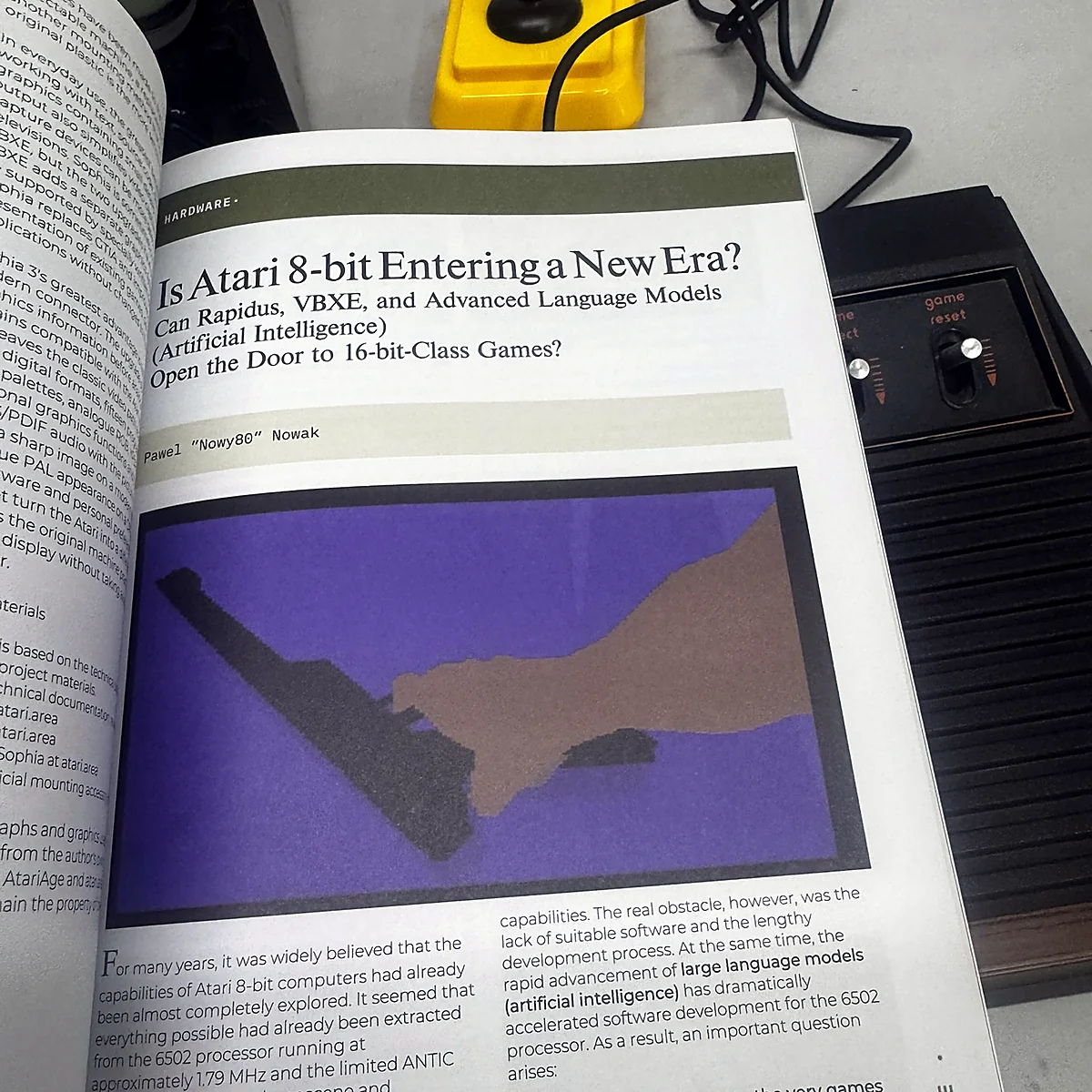
- Is the Atari 8-bit entering a new era? Can Rapidus, VBXE and large language models open the door to 16-bit-class games? For years the assumption was that a 6502 running at roughly 1.79 MHz, with ANTIC and GTIA beside it, had been explored to its limit. The expansions raised the ceiling. What stayed in the way was software, and the time it takes to write it, and that is exactly what AI-assisted 6502 development is now changing.
Software and programming
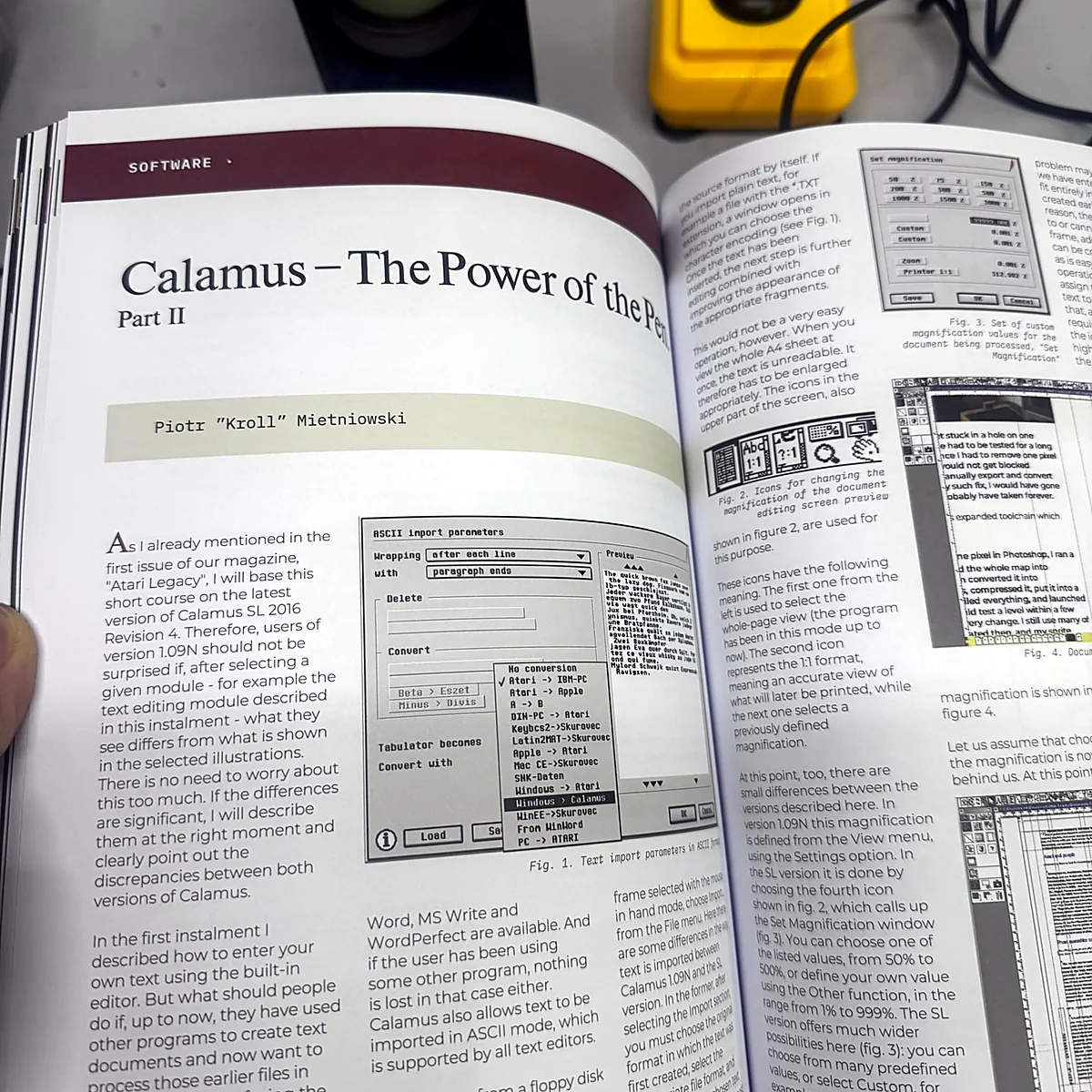
- Calamus. The Power of the Pen (Part 2). The DTP series continues: “power without the price”, how the ST quietly took over desktop publishing, and why Calamus became a cult.
- Mad-Pascal. Chapter 2: Bomber. The cross-development series continues, building a complete game step by step with Mad-Pascal and the MADS cross-assembler.
- Where does intelligent or life-like behaviour come from? Artificial Intelligence, Artificial Life and the Infinity of Fractals on Classic Atari Machines (Part 1). People who do not know the history of AI tend to date the field to 2012, or to 2017, and to picture room-sized mainframes at MIT or Stanford. In 1984 Joseph Hafner sat in front of an Atari 800 with 16 kilobytes of RAM and wrote a BASIC program that taught itself to play Tic-Tac-Toe.
Story
- The Atari I Somehow Missed. A 2600 loyalist meets a real Atari computer for the first time, at a friend’s house, with a dyed-in-the-wool IBM father driving him there. The same father who once called the people who made those games geniuses.
- A Garage Full of Worlds. The 2600. A garage packed with Atari 2600 consoles, and the worlds still sitting inside them.
Coming in Issue 03, out December 8, 2026
- MIDI environment configuration
- Mad-Pascal: sound and colours
- Interview with Carl Fornhan (Songbird Productions)
- The story of the Atari VCS, the most important console in history
Why this issue belongs on your shelf
- The ReFalcon, first-hand. The first working Falcon motherboard replica in over thirty years, documented by the people closest to it.
- Made on the metal. Typeset on a real Atari Falcon030 in Calamus. As far as we know, no other magazine on Earth is produced this way.
- First-hand material. Party reports, developer interviews, and hardware tested by people who actually use it.
- Ninety-two pages, full colour, perfect-bound. Made to be kept.
- Limited first print run at an introductory launch price.
- Written in English for the worldwide Atari community.
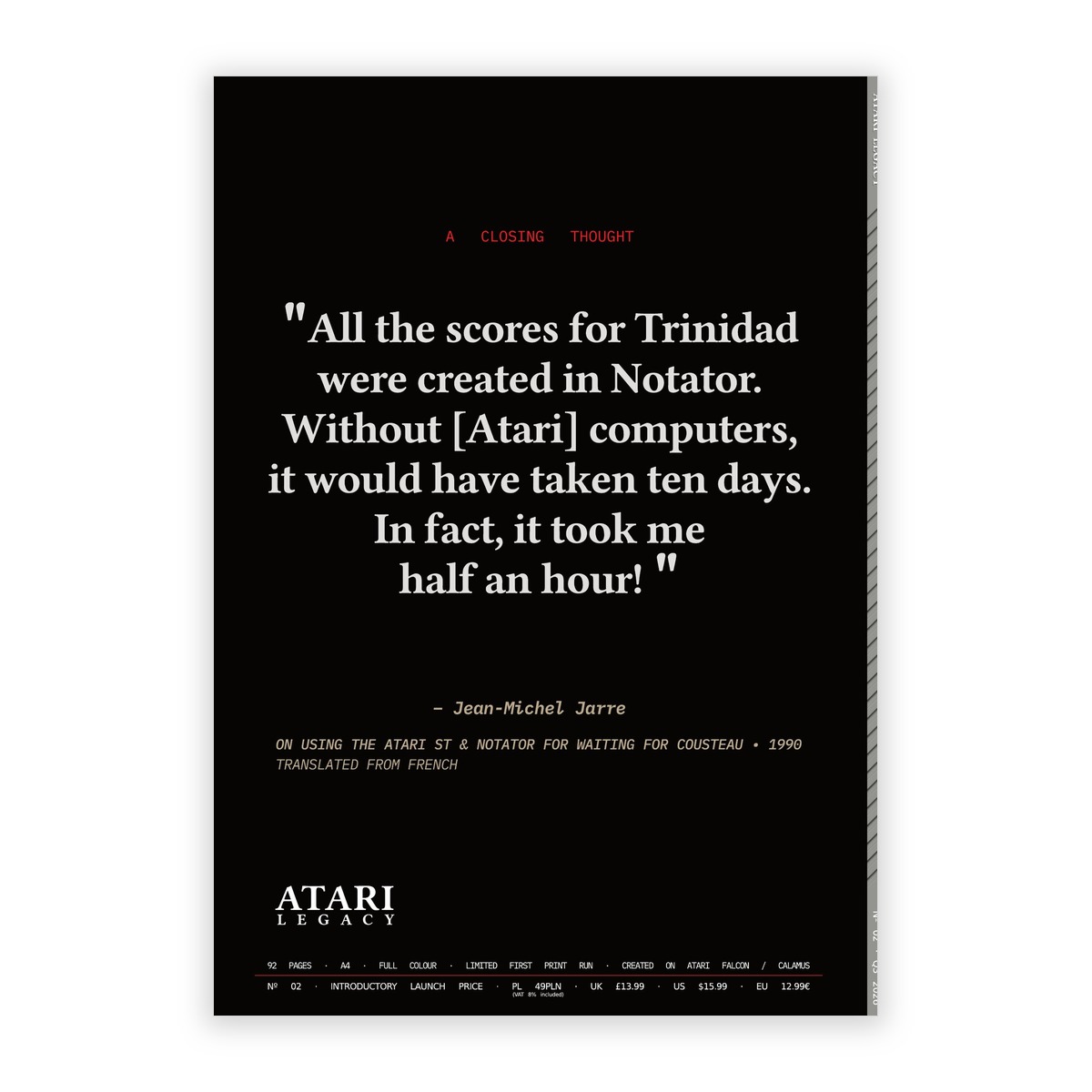
“All the scores for Trinidad were created in Notator. Without [Atari] computers, it would have taken ten days. In fact, it took me half an hour!”
Jean-Michel Jarre, on using the Atari ST and Notator for Waiting for Cousteau, 1990. The closing thought of Issue 02.
Product specifications
Published by LTEK Labs, and carried to the world through iAmats.com. Atari Legacy reaches the worldwide Atari community through LTEK Labs, the publishing house affiliated with L-TEK Sp. z o.o., founded by Tomasz “tekatom” Krupnik, founder of L-TEK. For Tomasz this is not nostalgia for its own sake. It is a living thread: the same machines that fill these pages, from the 8-bit BASIC of the XL/XE to the Falcon030, shaped a lifetime of building. The issue appears under the patronage of Katarzyna and Tomasz Krupnik. The magazine has its own home at atarilegacy.com.
Bring the Atari to your feet. The magazine celebrates these machines. L-TEK lets you play one with your whole body. The Atari XE/XL Converter connects an L-TEK dance mat to a real Atari, so you can play Star Dance, the L-TEK rhythm game for Atari.
| Weight | 0.3 kg |
|---|---|
| Dimensions | 25 × 35 × 1 cm |
Testimonials and tales shared by our dance family


Love it! I used cheap foam pads for a few months, but could feel their limitations (sliding, inconsistent detection, etc). This new metal pad felt like a clear upgrade. The price is a little steep but feels fair given the quality of the board.
Highly recommend!
Marvelous pad. They’re sturdy enough for playing with shoes. I removed the center screws for each arrow and found the sensitivity to be fantastic. Well worth the price.
This pad is amazing!! Don’t listen to anyone saying theyre “not good enough” even without any mods, the pad feels exactly like the arcade! <3 Thank you iAmats for this amazing pad! i'd give it 20 stars if i could.
This pad is amazing!! Don’t listen to anyone saying theyre “not good enough” even without any mods, the pad feels exactly like the arcade! <3 Thank you iAmats for this amazing pad! i'd give it 20 stars if i could.
This pad is amazing!! Don’t listen to anyone saying theyre “not good enough” even without any mods, the pad feels exactly like the arcade! <3 Thank you iAmats for this amazing pad! i'd give it 20 stars if i could.
Read more reviews on our Reddit
community!
Become a Master
Watch gameplay from CowEye - [DDR] All Star - Smash Mouth

Sensitive, Durable. Perfect for players who enjoys playing without bar like me. Thanks LTEK!
 YouTube - 1M subscribers
 TikTok | 378k followers
 Instagram | 70k followers
CowEye
L-tek ambasador
Others also bought:
FAQ
Frequently asked questions
Stepmania LTEK is a popular choice for dance mat users due to its simple operation and easy song customization. L-TEK also offers the Connect Buddy, a tool that links Stepmania with the PADY Fitness iOS app, allowing you to monitor your training progress. Both tools are available in our Software section.
Stepmania LTEK can also integrate with the Amusement Lights Controller, adding dynamic lighting effects for enhanced gameplay.
For additional options, LTEK Interactive Mats are compatible with various games to combine fitness and entertainment. Find a list of recommended games in our Games to Play on Mat section.
L-TEK Dance Mats are compatible with PlayStation 2 and PSX consoles using a dedicated converter available in our store. Converters specifically designed for PlayStation 2 and PSX can be found in the PS2 & PSX converter section.


